 Attuned
“She said more in her third session than she'd said to us in six months.”
A 20-minute call. No commitment. No intake forms yet.

Play Therapy
Children speak in gestures first.
3 families
started their first session
Licensed
Child & Adolescent Psychologist
For Parents
Questions parents search
at midnight
Real answers. No clinical jargon. Each question is one we've heard from a parent in our waiting room.
How do I know if my child actually needs therapy?
Most parents who call us aren't sure — and that uncertainty is completely normal. We look for patterns that persist for more than a few weeks: sleep disruption, school refusal, explosive anger that doesn't match the situation, withdrawal from friends, or physical complaints with no medical cause. One worried call doesn't mean anything is wrong. It means you're paying attention.
“I kept telling myself it was a phase. After our first call with Dr. Attuned, I realized I'd been waiting eight months for a phase that wasn't going to pass on its own.”
What does my child actually do in a session?
We don't sit across a desk and ask questions. Most sessions happen on the floor. We use sandtray figures, art materials, puppets, and carefully chosen games — because children process emotion through play, not conversation. Your child leads. We follow, and we listen to what their choices tell us. By the third or fourth session, most children ask to come back.
“I expected him to resist going. Instead, he started telling me about 'the sand world he built' at dinner. That's when I knew something real was happening.”
Will my child actually open up to a stranger?
Children are remarkably perceptive about safety. We spend the first two sessions doing nothing but playing — no agenda, no probing, no 'tell me about your feelings.' Trust is built through consistency and patience. Children who've barely spoken at home have drawn pictures that told us everything within four sessions. The sandtray especially — there's something about arranging small figures that bypasses the guard.
“She'd barely spoken at school for three months. After her fifth session, her teacher pulled me aside to say she'd raised her hand in class for the first time all year.”
How long does this take, and what does it cost?
Sessions are 50 minutes, $195 each. Most families see meaningful change in 8–12 sessions. Some children do 6 and are done. Others come monthly for two years — it depends on what we're working with. We don't keep children in therapy longer than necessary; that's not how trust works. We offer a sliding scale for families experiencing financial hardship. Insurance reimbursement letters are provided on request.
“We budgeted for six months and were done in eight sessions. I'd have paid twice that for what changed in our house.”
“I didn't realize how much I needed someone to tell me my child wasn't broken. That I wasn't broken. That this was workable.”
“By the time we booked the call, I'd already decided. The page answered every question I was afraid to ask out loud.”
20-minute call · No commitment · No waitlist right now
How We Work
Children speak in
gestures first.
Every method we use is evidence-based and adapted to the individual child. We don't apply a template. We build a relationship, and the work follows.
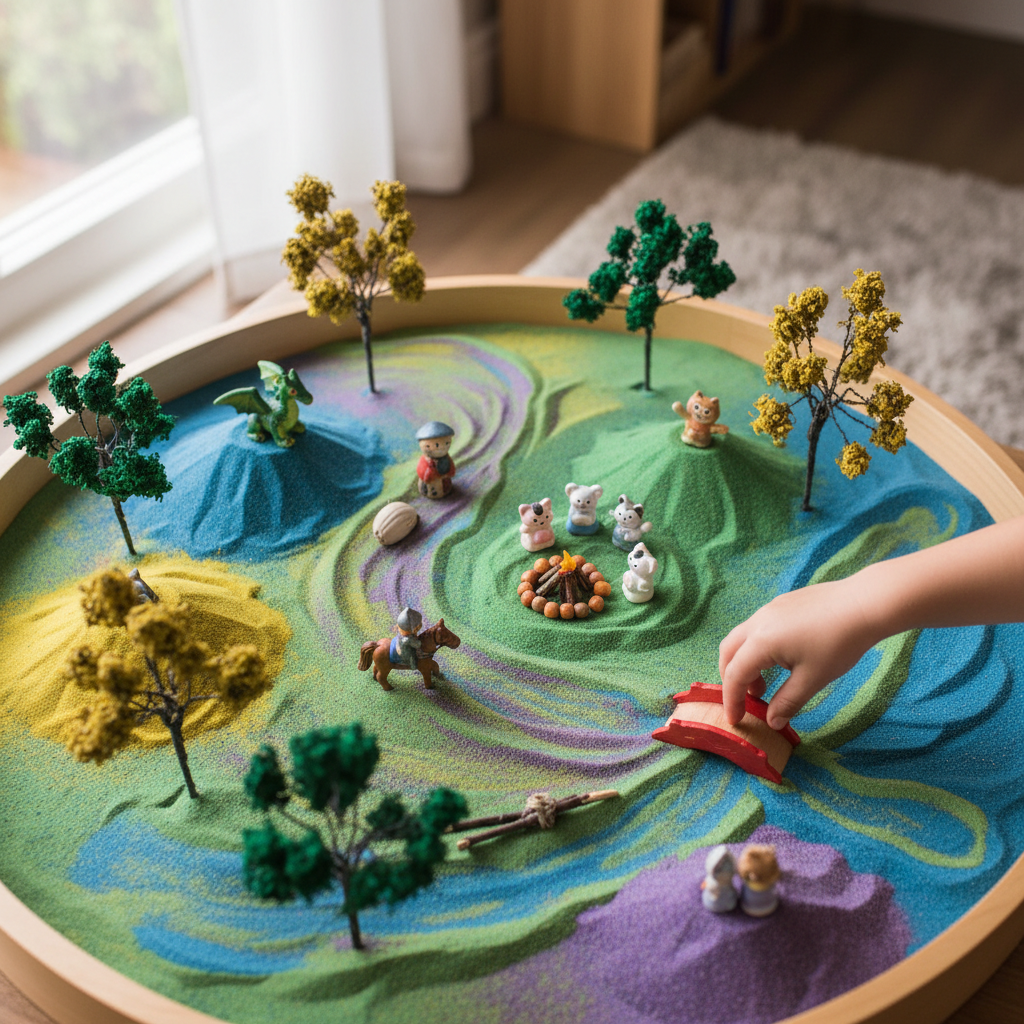
The sand holds what words cannot yet carry.
Sandtray Therapy
Children arrange miniature figures in sand to externalize their inner world — conflicts, fears, and relationships become visible without words.
Expressive Arts
Drawing, clay, and collage give children a language for experiences they can't yet name. The art holds what words cannot.
Child-Led Play
We follow the child's lead entirely. Directive only when safety requires it. Trust is the mechanism through which everything else works.
“I kept waiting for the catch — the sales pitch, the package deal. It never came. Just honest conversation about what my kid needed.”
20-minute call · No commitment · No waitlist right now
Parent Stories
What families
say afterward
400+
children seen
12 yrs
in practice
4.9
avg. rating
“I came in expecting worksheets and homework. What we got was a completely different child by month three — calmer, less explosive, actually talking about his day. I don't know exactly what happens in those sessions and I don't need to.”
“The divorce was hardest on her, not us. We knew that. What we didn't know was how to help without making it worse. Dr. Attuned taught us that too — how to be the stable thing she could come back to.”
“Her pediatrician referred us after the third time she came in with stomachaches we couldn't explain. Eight sessions later, the stomachaches are gone and she's sleeping through the night. The body keeps score — that's what I learned.”
“He'd been diagnosed with ADHD and I was worried therapy would just be more adults telling him what to do. Instead, he told me it was 'the only place where he got to be in charge.' I almost cried.”
“The waiting room alone made me feel better. Soft chairs, good light, no fluorescent buzz. Someone had thought carefully about what a scared child needed before they even walked through the door.”
“My son hadn't cried since he was four. He's nine now. In his seventh session, he cried. His therapist told me that was the work. I went home and cried too.”
Or call us: (503) 555-0142